And the ‘Hot N Cold’ reactions
By Abigail Doherty
Jeff Bezo’s Blue Origin successfully launched the first all-female space mission since 1963’s Valentina Tereshkova’s solo space flight, which sent the first woman to space.
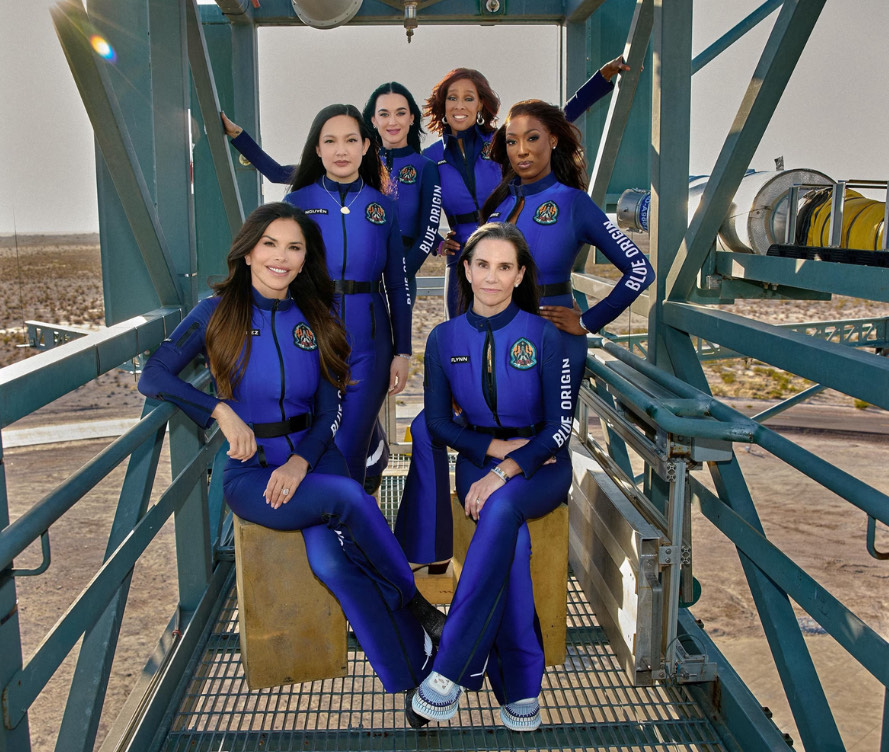
The crew consisted of singer-songwriter and popstar, Katy Perry; journalist and author as well as Bezos’ fiancée, Lauren Sanchez; author and CBS news journalist, Gayle King; civil rights activist, Amanda Nguyen; aerospace engineer and former rocket scientist, Aisha Bowe; and film producer, Kerianne Flynn.
The 10 minute flight was enough to make history, sending the first person of Bahamian heritage, and the first Vietnamese and Southeast Asian woman to space. Not to mention, the inspiration of an all-female crew which boasted a group of successful and talented people, empowering women to take daring risks.
Sanchez chose her crew hoping “to inspire new generations to be interested in space exploration”. And Amanda Nguyen emphasized the significance of gender-based violence being the reason that women in STEM don’t continue with their training, a situation she is all too familiar with and passionate about preventing.
So it sounds like the intentions were pure, and the purpose of the mission was to empower young women and recognise women in STEM for their contributions to aerospace and space technology.
A message seemingly lost in translation.
The women sported jumpsuits specially designed by the fashion brand, Monse, which designers Fernando Garcia and Laura Kim “tailored to fit a woman”. Garcia envisioned a suit “that was a little dangerous, like a motocross outfit. Or a ski suit. Flattering and sexy.” Kim visualised a “slim and fitted suit”.
The designing of the suits created an exciting opportunity to showcase a suit with women’s bodies in mind, diverging from the gear traditionally tailored for a man’s body and proportions. In 2019, the first all-female spacewalk was cancelled by NASA following the revelation that they did not have two suitably sized spacesuits for the participating women. As a result, a man and a woman went up to space instead.
So what was so problematic about the visions the designers and crew had for Blue Origin’s space suits? The most obvious issue is in the sexualisation of the women, and oversaturated notion that women have to perform even in something as extraordinary as going to space. The message that was intended to be sent to inspire young women and younger generations is overshadowed and replaced by a reminder of society’s rigorously harsh beauty standards and gender-normative attitudes.
Many celebrities have reacted via social media, in protest of the space venture. Model and actor, Emily Ratajkowski, said in a TikTok video, that she was “disgusted” by the launch, calling it “beyond parody”. Others chose a more light-hearted form of mockery. Comedian, Amy Schumer, posted a sarcastic video on her Instagram joking that she was invited to join the Blue Origin crew, attracting the attention of over a million Instagram users, who viewed the post.
The crew vehemently defended the launch however, King claiming that those who criticise the mission “[don’t] really understand what is happening here”. She told People: “We can all speak to the response we’re getting from young women from young girls about what this represents.”
Admittedly, it is a huge success and step forward for space tourism and travel, which has come a long way, and represents a more inclusive landscape in the aerospace industry.
On the other hand, there is an infuriating reality that this was a space mission that no one asked for, and one that takes centre-stage in news coverage, whilst death tolls rise in the Israeli-Palestinian conflict, in Russia and Ukraine, in the Sudanese civil war and the civil war in Myanmar.
Those are just of the few of the devastating events claiming the lives of innocent civilians whilst out of touch celebrities orbit the Earth for ten minutes. Ten minutes that for many is the difference between living and dying. Escape and capture. Fighting and surrendering.
 Winchester Journalism Society